Rosario Cybernetics · 2026
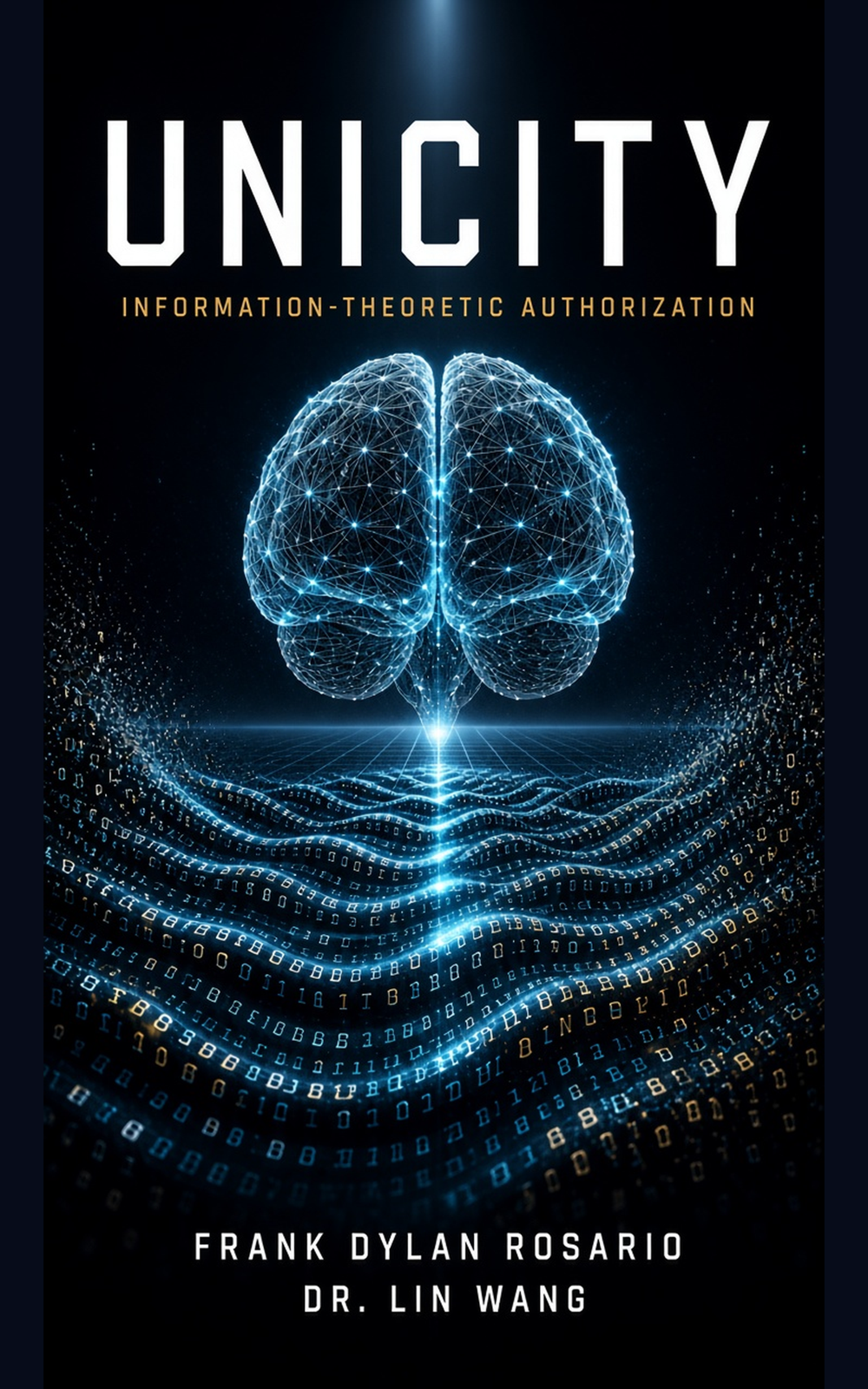
UNICITY
Information-Theoretic Authorization
Frank Dylan Rosario and Dr. Lin Wang
UNICITY asks whether an observation changes justified belief about a hidden object under a named model, then carries Shannon's secrecy ruler from messages to authorization transcripts.
Abstract
A first-draft book on copied authority objects, Shannon's secrecy ruler, transcript secrecy, anti-unicity, and the Rosario / ENI6MA construction. Measurement and argument, not implementation guidance, legal advice, or a deployment warranty.
For forty years the internet has treated possession as authority. If you can present the password, the token, the card number, the API key, or the recovery code, the system treats you as the person who may act. UNICITY is a book about that design choice. It begins with Claude Shannon's 1949 standard of perfect secrecy: the condition in which seeing the ciphertext does not update an observer's belief about the message. From the one-time pad, entropy, mutual information, and unicity distance, the book builds a ruler for a different question. What object crosses the wire when a system grants access? What does a passive observer learn by recording it? Can the recorded object be reused as authority?
A different way of proving identity
UNICITY asks whether an observation changes justified belief about a hidden object under a named model, then carries Shannon's secrecy ruler from messages to authorization transcripts.
Possession as authority
Most systems treat possession of a copyable artifact as authority. If a verifier accepts the password, the token, the card number, or the API key, a later holder of a copy can present the same object. UNICITY is a book about that design choice.
Shannon's ruler
Claude Shannon's 1949 standard of perfect secrecy is the condition in which seeing the ciphertext does not update an observer's belief about the message. UNICITY carries that ruler from messages to authorization transcripts: it asks whether an observation changes justified belief about a hidden object under a named model.
What a verifier observes
Under that named information-theoretic model, a verifier can check a scoped authorization outcome without the observed transcript updating belief about the hidden authority object the way a static credential does. The verifier observes a pass/fail or other scoped check. The verifier does not receive the secret material outside the defined protocol.
Scope of the claim
The claim is measurement and argument in a first-draft book. It is not implementation guidance, legal advice, or a deployment warranty. It is not a claim that a product or deployment is perfectly secure.
Availability
Coming soon to Amazon and Kindle. Audiobook expected 2027.
Paperback ISBN 979-8-9980466-6-7. EPUB ISBN 979-8-9980466-5-0. No retail listing is live yet.
WavePSI research
The lab's second pillar. Experiential-intelligence notes remain on this site. They are research, not chapters of the book.
Papers
The public shelf now includes the 2026 unification paper and the observer-bit budget paper. Earlier product PDFs were archived.
- New Dimensions in Zero-Information Cryptography (2026)
- The Observer's Bit Budget (2026)
The authors
Frank Dylan Rosario is a principal AI architect and AGI/HPC researcher based in San Francisco. He is the founder of Rosario Cybernetics and chairman of ENI6MA. Earlier he served as CIO of Rowzzy, senior AI architect at Samsung, and ML architect at Oracle. His work centers on information-theoretic authorization and identity systems: what an observed transcript can teach a recorder, when possession of a secret is mistaken for a right to act, and how classical secrecy conditions still apply once the object on the wire is no longer only a message.
Dr. Lin Wang (also known as Grant Wang) holds a Ph.D. in Electrical and Computer Engineering from Duke University (2013). He is a machine learning engineer at Phia, based in the San Francisco Bay Area. Earlier he served as principal machine-learning engineer at Vungle/Liftoff, chief technology officer at Rowzzy, and staff AI research scientist at Samsung Research America. He is co-author of this volume and of the Rosario–Wang construction in Part IV. His contribution is the information-theoretic analysis of that construction and its comparative framing against public-key and zero-knowledge primitives.